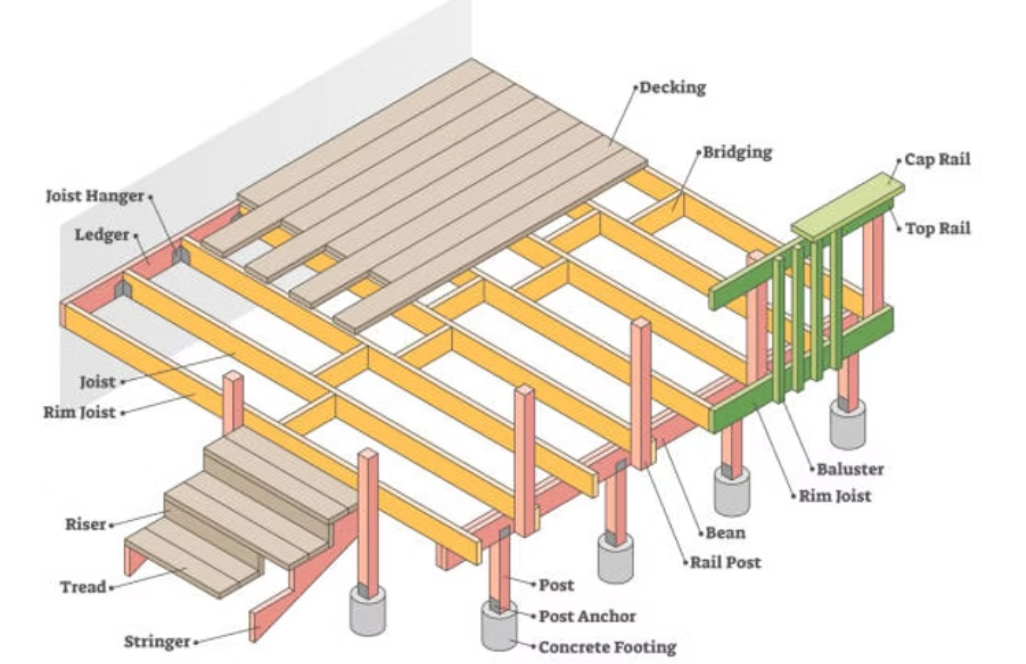
Deck parts:
Stairs: See Stairs.
Railing: See Railing.
Substructure: Is the framework that lies underneath your deck board. It is the actual structural support for the deck and provides it with much-needed strength to make it safe and secure. Your substructure and its shape and size very obviously depend on the type of deck that you have. Different deck layouts will require variations in the substructure construction.
Decking: Are the boards used to create the floor/walking surface of your deck.
Fasteners: Screws or clips that attach the decking to the substructure.
Components of the substructure:
Beam: The primary structural support of the deck, it is supported by posts and the joists rest on it (and are connected using hardware).
Blocking/Bridging: Small boards used to provide lateral support and to prevent twisting of the joists.
Concrete footing: Provide a solid foundation to help spread the load of your deck over a greater surface area. Typically, the best type of footing is a concrete pillar that is poured into a hole you dig in the ground. In cold climates, the bottom of your footings will need to extend below the frost line, which varies geographically to prevent the concrete from shifting as the ground freezes and thaws.
Decking: Are the boards used to create the floor/walking surface of your deck.
Joist: The boards that run from ledger to rim joist that provide the surface for the decking to be adhered to.
Joist Hanger: The brackets that are used to connect the joist to the ledger board.
Ledger Board: The board that anchors the deck to the structure it is being attached to. The joist are connected to the ledger board with joist hangers.
Post: The post is connected to the footing and the beam.
Rim Joist: A board that attaches to the joist ends and provides lateral support.
Resurface: Is the processing of replacing decking on an existing substructure.